A Better Hope

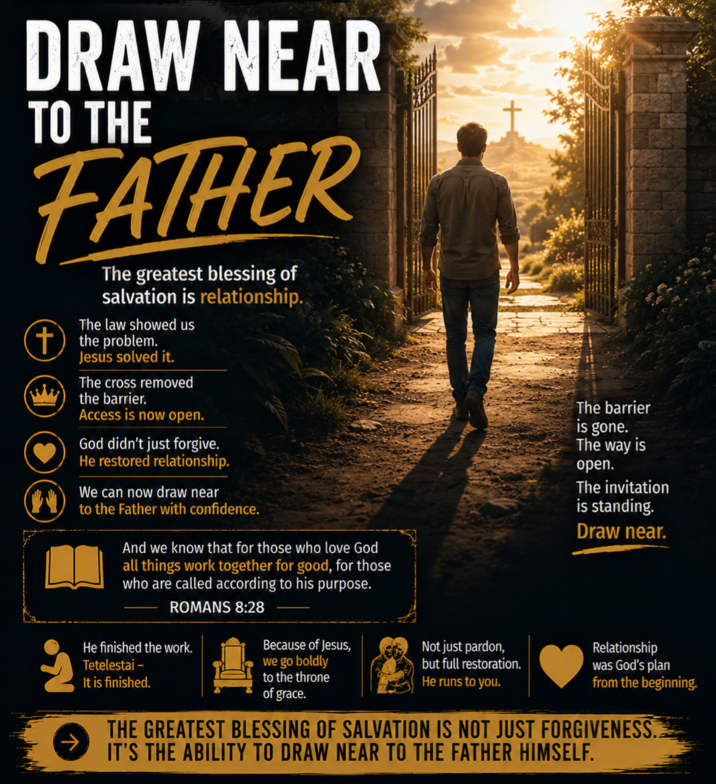
What is the greatest blessing of being saved? Forgiveness? Eternal life? Peace? These are all real and meaningful gifts. But there is something even deeper at the heart of salvation that we often overlook. It is the ability to draw near to God Himself.
What Does the Book of Hebrews Say About Jesus?
Throughout the book of Hebrews, one theme keeps surfacing: Jesus is better. Better than the angels. Better than Moses. Better than Abraham. And in Hebrews chapter 7, verses 11 through 19, the focus turns to something called "a better hope."
This passage is written to new believers who came from a Jewish background and were being tempted to return to their old religious system. The writer of Hebrews is reminding them that they chose the right path, and that Jesus is not just another option. He is the fulfillment of everything the old system pointed toward.
Why Was the Old Law Not Enough?
Hebrews 7:11 opens with a rhetorical question: "Now if perfection had been attainable through the Levitical priesthood, for under it the people received the law, what further need would there have been for another priest to arise after the order of Melchizedek, rather than one named after the order of Aaron?"
The word "perfection" here does not mean sinlessness or flawlessness. In the original Greek, it carries the meaning of completion, of something reaching its intended goal. The law was never designed to make people complete on its own. Its purpose was to reveal sin, to show us how far we fall short of God's standard of holiness.
Think of it like an X-ray. An X-ray can show you exactly where a bone is broken and give a clear diagnosis. But the X-ray cannot heal you. In the same way, the law can show you the problem, but it cannot fix it.
Who Is Melchizedek and Why Does It Matter?
The passage draws a contrast between two types of priests: those after the order of Aaron (the Levitical priesthood) and the one after the order of Melchizedek. To be a priest under the old system, you had to come from the tribe of Levi and trace your lineage through Aaron. It was entirely based on bloodline and legal requirement.
But Jesus came from the tribe of Judah, not Levi. He did not qualify under the old system. So how is He a priest? Hebrews 7:16 answers that directly: He "has become a priest not on the basis of a legal requirement concerning bodily descent, but by the power of an indestructible life."
Melchizedek, introduced back in Genesis 14, was both a king and a priest. His name means "King of Righteousness," and his title was King of Salem, meaning "King of Peace." There is only one who is both King and Priest, whose name is Righteousness and who is Peace. That is Jesus.
Psalm 110:4, written thousands of years before Hebrews, declared: "You are a priest forever, after the order of Melchizedek." Jesus fulfilled this prophecy not because of His earthly ancestry, but because God Himself swore an oath that He would.
What Does "It Is Finished" Really Mean?
There is a powerful connection between the word used for "perfection" in Hebrews 7:11 and the word Jesus spoke from the cross. In Hebrews, the word points to something that could not be completed. On the cross, Jesus cried out "Tetelestai," which means "It is finished." It is completed.
In Hebrews, the word is a noun. On the cross, it was a verb. A verb is action. Jesus did not simply describe what needed to happen. He did it. He took the power into His own hands and finished what the law never could.
The law could not perfect anything. But Jesus, hanging on the cross, declared with His own voice that the work was done. Your salvation, and the restored relationship between you and God the Father, was made possible because He completed it.
What Is the "Better Hope" in Hebrews 7:19?
Hebrews 7:18-19 says: "For on one hand, a former commandment is set aside because of its weakness and uselessness, for the law made nothing perfect; but on the other hand, a better hope is introduced, through which we draw near to God."
That phrase, "through which we draw near to God," is the heart of the entire passage. The better hope is not just about escaping punishment or earning a place in heaven. It is about restored relationship with God the Father.
All the way back in the Garden of Eden, God walked through the garden calling out, "Where are you?" Fellowship had been broken. But even then, God covered their sin and made a way. That has always been His desire: to be close to His people.
The cross did not simply remove guilt. The cross removed the barrier between you and your Father.
Is Relationship With God the Greatest Blessing of Salvation?
Forgiveness is real. Heaven is a genuine promise. Peace and eternal life are gifts worth celebrating. But what we cannot miss is that God did all of this so that He could have a relationship with you.
You do not need an earthly intercessor. You have a High Priest after the order of Melchizedek, and His name is Jesus. He makes intercession on your behalf continually. Because of Him, you can go boldly to the throne of grace.
The story of the prodigal son illustrates this beautifully. When the son returned home after wasting everything, the Father did not simply forgive him and send Him to the servant quarters. He ran to him, embraced him, clothed him, put a ring on his finger, and threw a celebration. He said, "This my son was dead, and is alive again; he was lost, and is found."
That is the picture of what God offers through Jesus. Not just pardon, but full restoration of fellowship.
Life Application
Jesus took action where the law could not. He finished the work. This week, take a step toward God by shifting how you begin your time with Him. Instead of opening with a list of requests or even an apology, try starting with gratitude. Say, "Father, thank you. Because of Jesus, I can come near to You." Then simply sit in His presence before anything else.
The access has already been granted. The barrier has already been removed. The work is already finished. The only question is whether you will take advantage of what He has made available to you.
Ask yourself:
- Am I treating my relationship with God as the greatest gift of salvation, or am I focused only on what I receive from it?
- Do I actually draw near to God each day, or do I keep Him at a distance even though the way has been opened?
- What would it look like this week to spend time simply enjoying God's presence before bringing Him my needs?
The law showed us the problem. Jesus solved it. And the greatest result of that solution is not just a clean record. It is a restored relationship with the God who has been pursuing you all along.