Hidden in Plain Sight

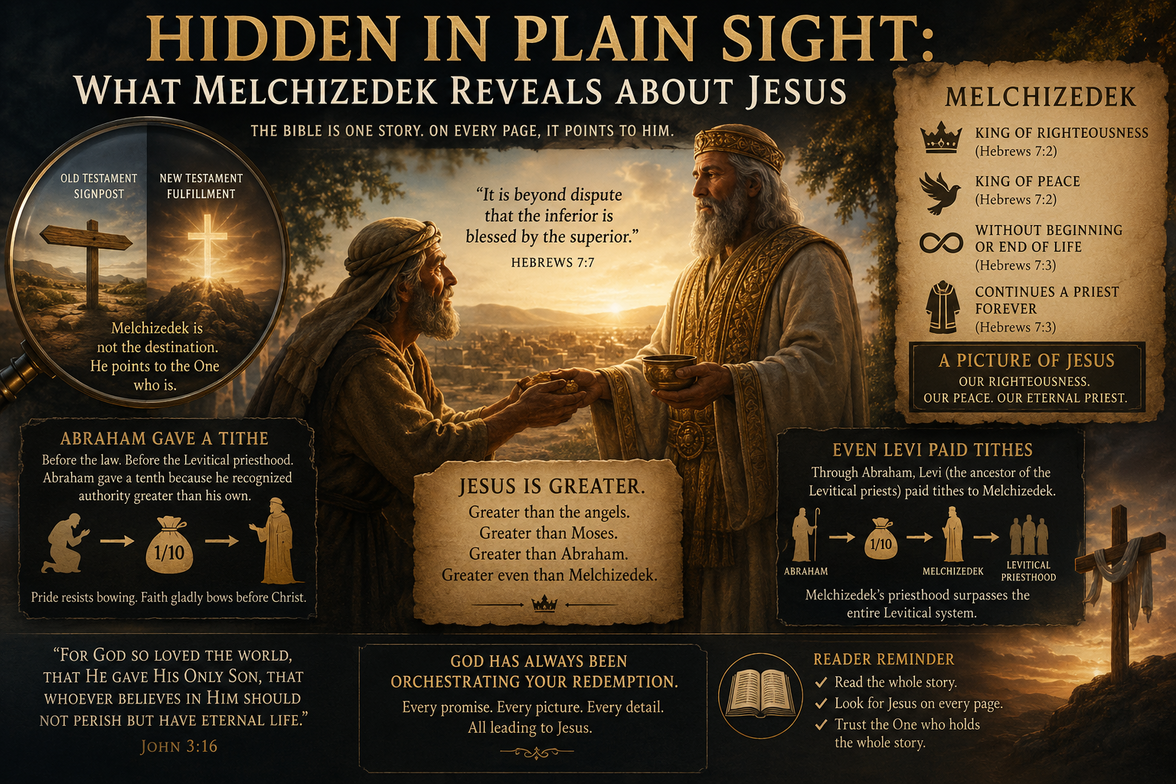
The Bible is one unified story, and once you know how to look, you begin to see Jesus on every page. Hebrews chapter 7 gives us one of the most fascinating examples of this. A mysterious figure named Melchizedek appears briefly in the Old Testament, and most readers pass right over him. But he is not the destination. He is a signpost pointing directly to Christ.
Why Does the Bible Mention Melchizedek at All?
Melchizedek shows up in Genesis 14 when Abraham is returning from battle. He appears suddenly, with no introduction, no family history, and no recorded death. He blesses Abraham, and Abraham gives him a tenth of everything he had won in battle.
That is essentially all we know. And yet the writer of Hebrews spends an entire chapter unpacking why this matters deeply for every believer.
The key is perspective. Like one of those optical illusion images where you can see two different pictures depending on how you look, the Old Testament contains things hidden in plain sight. Once you know who Jesus is, you begin to see Him woven throughout scripture in ways you never noticed before.
What Does the Name Melchizedek Actually Mean?
Hebrews 7:2 gives us two important details about Melchizedek:
- His name means King of Righteousness
- His title, King of Salem, means King of Peace
Those two descriptions should immediately bring someone to mind. Jesus is our righteousness and our peace. This is not a coincidence. It is foreshadowing.
There is also a meaningful order here. Righteousness comes first, then peace. You will never experience true peace until you have first received the righteousness that comes through Christ. Peace does not precede righteousness. It follows it.
How Is Melchizedek a Picture of Jesus?
Hebrews 7:3 describes Melchizedek as being "without Father or mother or genealogy, having neither beginning of days nor end of life, but resembling the Son of God. He continues a priest forever."
This does not mean Melchizedek was literally never born or never died. It means the scripture is completely silent on those details. There is no birth record. There is no death record. No family tree. No origin story.
For the writer of Hebrews, that silence is intentional. It mirrors something true about Jesus, who exists outside of time. Jesus had no beginning and has no end. He was present at creation. He is eternal. Melchizedek's mysterious appearance in scripture is a shadow of that eternal nature.
As it says in Hebrews 7:3, he is one "resembling the Son of God" who "continues a priest forever."
Why Did Abraham Give Tithes to Melchizedek?
This is one of the most striking details in the passage. Abraham, the Father of the nation, the man who received God's covenant promises, willingly gave a tenth of everything to Melchizedek. And he did it before the law ever required it. There was no commandment. There was no Levitical priesthood yet. Abraham gave out of his heart because he recognized the greatness of who stood before him.
Hebrews 7:4 says, "See how great this man was to whom Abraham the patriarch gave a tenth of his spoils."
The point is not just that Abraham tithed. The point is what that act of giving reveals. Abraham was acknowledging a higher authority. The greatest patriarch in Israel's history willingly bowed before someone greater than himself.
Pride resists bowing. But faith gladly bows before Christ. When we give, serve, and worship, we are doing something similar. We are acknowledging that Jesus holds a position greater than anything or anyone else in our lives.
What Does It Mean That the Lesser Is Blessed by the Superior?
Hebrews 7:7 states plainly, "It is beyond dispute that the inferior is blessed by the superior."
Melchizedek blessed Abraham. Abraham received the blessing. That means, by the logic of scripture itself, Melchizedek held a position of greater authority than Abraham.
For the original Hebrew readers of this letter, that was a world-shaking statement. Abraham was the Father of their nation. He was revered above almost everyone. But the writer is systematically dismantling the idea that any human figure, whether an angel, Moses, or Abraham, is the one to be followed and worshiped above all others.
The argument builds toward one conclusion: Jesus is greater. Greater than the angels. Greater than Moses. Greater than Abraham. Greater even than Melchizedek, who himself was greater than Abraham.
What About the Levitical Priesthood?
Hebrews 7:9-10 makes a fascinating theological point. It says that Levi himself, the ancestor of all the priests who would later collect tithes from the people, actually paid tithes to Melchizedek through Abraham. Because Levi was not yet born, he was still, in a sense, in Abraham's lineage when Abraham gave that tithe.
The implication is significant. Even the entire Levitical priesthood, the system of priests that Israel had depended on for generations, was in a sense subordinate to Melchizedek. And if Melchizedek points to Jesus, then Jesus holds a priestly authority that surpasses the entire Levitical system.
This sets up what the following verses will explore more fully: the Levitical priesthood was never the final answer. It was always pointing forward to something better.
Is Melchizedek Actually Jesus Appearing in the Old Testament?
Some have suggested that Melchizedek was a physical appearance of Jesus in the Old Testament. It is worth being careful here. Scripture does not explicitly say that. What it does say is that Jesus is a high priest "after the order of Melchizedek," meaning in the likeness of, or in the pattern of.
Melchizedek is a type, a foreshadowing, a signpost. He is not the destination. The destination is Jesus. Do not get so focused on the signpost that you miss where it is pointing.
Your beliefs should always be grounded in what scripture explicitly says. When we add ideas that are not clearly supported by the text, we can wander into territory that is not founded in the Word of God.
God Has Always Been Orchestrating Your Redemption
Here is the big picture takeaway from these ten verses. God has been weaving the story of redemption since the very beginning. Nothing about Jesus arriving on the scene was accidental or reactive. It was always the plan.
"For God so loved the world, that He gave His only Son, that whoever believes in Him should not perish but have eternal life." - John 3:16
From Genesis 14 to Hebrews 7, God was laying the groundwork. Every picture, every promise, every mysterious figure like Melchizedek was part of a tapestry being woven long before any of us could see the full design.
When you cannot see what God is doing in your life right now, that does not mean He is absent. It may simply mean you are still in the middle of the story. He has always been there, and He always will be.
As you read scripture, keep asking yourself: how does this point me to Jesus? Even the genealogies, the parts most people skip, are there for a reason. God kept the receipts. Every detail matters because it all leads to Christ.
Life Application
This week, take time to read Genesis chapter 14 and then Hebrews chapter 7. Read them back to back, more than once if you can. As you read, make a list of every way Melchizedek points to Jesus. Start with what was covered here: his name means King of Righteousness, his title means King of Peace, and there is no recorded beginning or end to his story.
Then carry that habit into the rest of your Bible reading. Every time you open scripture, ask: how does this point me to Jesus?
Ask yourself these questions as you reflect this week:
- Where in my life might God be working in ways I cannot yet see, and am I trusting His sovereignty in those areas?
- Is there any area of my life where pride is keeping me from bowing before Christ and acknowledging His authority?
- When I read the Bible, am I looking for Jesus throughout all of scripture, or am I only reading familiar passages?
God has been orchestrating your redemption since before you were born. The story of Melchizedek is proof that His plans run deeper and longer than we can fully comprehend. Trust the One who holds the whole story in His hands.