Who Gets the Final Word?

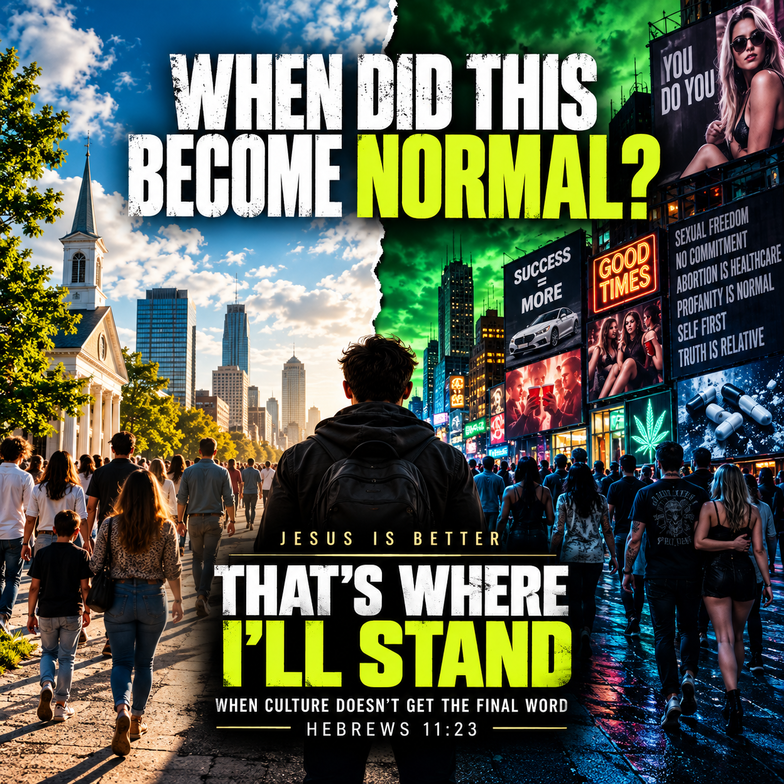
There is a quiet battle happening in every home, every heart, and every generation. It is not always loud or obvious. But the question at the center of it is simple: whose voice gets to define your life? The story of Moses' birth, tucked into one verse in Hebrews 11, gives us a powerful answer.
What Does Hebrews 11:23 Actually Say?
"By faith Moses, when he was born, was hidden for three months by his parents, because they saw that the child was beautiful, and they were not afraid of the king's edict." - Hebrews 11:23
One verse. But inside it is a decision that changed the course of history. And it has something to say to every one of us today.
What Is a Cultural "Edict" and Why Does It Matter?
Pharaoh's edict was easy to recognize. It was a direct command from the king: every Hebrew baby boy was to be thrown into the Nile. No ambiguity. No subtlety. Just a decree.
But the edicts of our culture today are far more subtle. They do not come written as commands. Instead, culture repeats a message until it starts to sound like truth. And eventually, we just accept it.
Those messages might sound like this:
- Your value comes from your appearance, your platform, or your influence.
- Success means a certain house, a certain salary, a certain lifestyle.
- If it feels right to you, it must be right for you.
- Your worth depends on what you achieve and how others see you.
- Old-fashioned thinking needs to catch up with the times.
Culture does not have to command us when it can condition us. And that conditioning happens through what we see and hear repeatedly, through what we scroll through, what we watch, what we celebrate, and what we normalize.
When Does Culture Become a Problem for Christians?
Culture in itself is not automatically the enemy. We live within culture. We participate in it and contribute to it. The problem comes when the voice of culture contradicts the word of God and we give culture greater authority than Scripture. That is where the break occurs.
Eventually, something can become so culturally normal that we stop asking the most important question: what has God said about this?
Absolute truth does not change based on what we choose to believe. North is still north. South is still south. And God's word is still true, whether we accept it or not.
What Made Moses' Parents Different?
When Moses was born, the law was clear. Every Hebrew son was to be cast into the Nile. But his parents looked at their child and saw something the culture could not see.
In the book of Acts, it says Moses was beautiful in God's sight. His parents recognized that this child had value to God. They had a stirring in their hearts that they could not ignore. And so they made a choice rooted in faith, not fear.
There were two verdicts about Moses in that moment. Pharaoh evaluated him by Egypt's interests and saw him as a threat to be disposed of. His parents viewed him through the lens of God's value and chose to protect Him.
Faith sees what the world cannot see.
How Do We Apply This to Our Homes and Families Today?
If we want to stand in the same faith that Moses' parents had, we cannot let culture be the loudest voice in our homes. We cannot hand our children and grandchildren over to whatever is popular or normal just because everyone else is doing it.
Culture wants to tell us who we are, what gives us value, what our bodies are for, what relationships should look like, and what should make us happy. Faith asks a different question: what does God say about it?
As Joshua 24:15 puts it: "But as for me and my house, we will serve the Lord."
That is not merely a belief. It is a declaration of whom we are going to serve. Every household is being formed by something. The question is whether that something is the word of God or the culture around us.
We may have to live in Egypt. But Egypt does not have to live in us.
What Does It Mean to Let Go in Faith?
For three months, Moses' parents hid him. But there always comes a point when faith means you have to let go.
"When she could hide him no longer, she got a papyrus basket for him and coated it with tar and pitch. Then she placed the child in it and put it among the reeds along the bank of the Nile." - Exodus 2:3
She technically did what Pharaoh commanded. She put her baby in the Nile. But she did not turn him over to the Nile. She turned him over to God.
And God made a way where there was no way. Pharaoh's own daughter found the baby. Moses' own mother was brought in to nurse him. And Pharaoh paid her to do it.
That is how God works. When we think it is over, when we push that basket into the water and let go, God comes on the scene and changes the rest of history.
How Do We Trust God With What We Cannot Control?
As parents, grandparents, and people of faith, there comes a moment when we can no longer hide the ones we love from the world. We disciple them, we pray for them, we prepare them. But we cannot control every outcome, every relationship, or every tomorrow.
We send them off in a basket called prayer. We bathe them in it constantly and turn them over to the hands of God.
Faith does what obedience requires. And then it trusts God with what obedience cannot control.
God's authority is greater than any Pharaoh's. His word is more trustworthy than any cultural voice. And He can be trusted with what is most precious to us.
What Are You Allowing to Shape You?
Here are some honest questions worth sitting with:
- What do I celebrate and normalize in my home?
- What receives my time and shapes my thinking?
- Whose voice carries the most authority in my life?
- Am I reading God's word and living my faith beyond Sunday?
- Am I modeling repentance, forgiveness, and obedience to those around me?
- What cultural edicts have I accepted without ever comparing them to God's word?
Faith is not a spontaneous impulse. It is a decision made before the pressure arrives. Moses' parents did not decide what to do the moment he was born. They had months to settle where they would stand. And they chose God's word over Pharaoh's command before the crossroads ever came.
Life Application
This week, make a deliberate decision about whose voice gets the final word in your life before the next moment of pressure arrives. Identify one area where you have allowed culture to quietly shape your thinking, your habits, or your home without measuring it against God's word. Then take that thing to Scripture. Pray over it. And choose to stand on what God says, not what feels comfortable or culturally acceptable.
If there is something tangled up in your life, a ball of anxiety, fear, or confusion, consider whether it is time to cut it loose and place it into God's hands. Stop trying to untangle what only He can resolve.
Ask yourself these questions as you go into the week:
- Whose word is actually governing my home and my decisions right now?
- What have I normalized in my life that I have never brought before God's word?
- Is there something I am still trying to control that I need to place into God's hands?
- Where will I stand when fear and culture collide with what Scripture says?
Faith chooses to believe God's word above everything else and stands firmly on that foundation. That decision is made today, before the trial comes.