When Faith Doesn't Change Your Circumstances

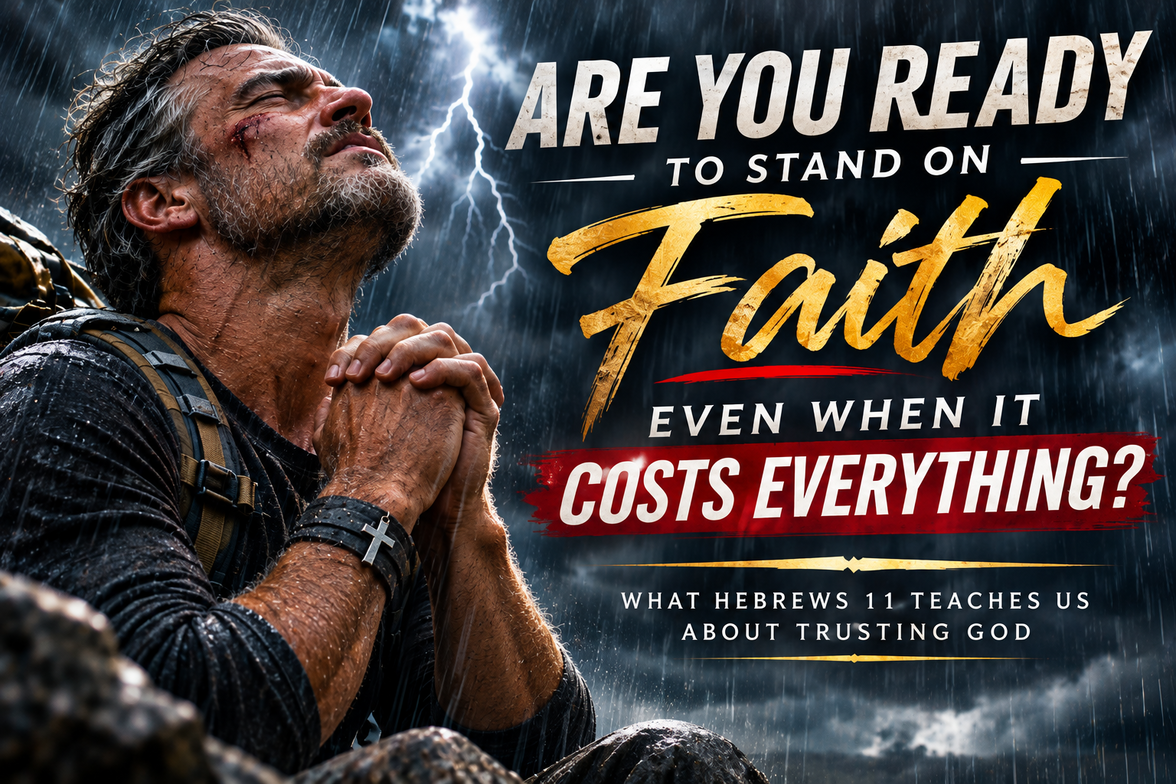
Faith is often misunderstood. Many people assume that strong faith leads to favorable outcomes, that if you pray hard enough and believe deeply enough, God will remove every obstacle. But Hebrews 11 tells a very different story, and it's one worth sitting with.
Does Unanswered Prayer Mean Weak Faith?
Consider two people praying for healing. One recovers. The other continues to suffer. Did one have more faith than the other? Did someone do something wrong?
It's easy to quietly assume that strong faith should produce the outcome we prayed for. But that assumption is far from the reality Scripture presents.
Hebrews 11 shows us people who escaped death by the sword and others who died by it. Some experienced great victories. Others, by every outward measure, seemed to face great failure. Yet God commended the faith of all of them.
What Is Faith, Really?
Hebrews 11 opens with a foundational definition: "Now faith is the assurance of things hoped for, the conviction of things not seen." - Hebrews 11:1
Faith is standing on God's Word. It means believing what God said is true, even when circumstances say otherwise. The facts might be stacked against you, but the truth is that God is on your side. Faith holds onto that truth regardless of what we see or feel.
The Hall of Faith: Victory and Suffering Side by Side
Hebrews 11:32-40 lists names like Gideon, Barak, Samson, David, and Samuel. The writer says time would fail him to name them all. And what did they accomplish through faith?
- Conquered kingdoms
- Enforced justice
- Stopped the mouths of lions
- Quenched the power of fire
- Escaped the edge of the sword
- Received back their dead by resurrection
That all sounds like a highlight reel. But then the passage takes a turn.
Others were tortured. Others suffered mocking, flogging, chains, and imprisonment. They were stoned, sawn in two, killed with the sword. They wandered in deserts and caves, destitute and mistreated.
And every single one of them received commendation for their faith.
Why God Doesn't Always Remove the Burden
Think about Gideon. He went into battle worried about having only 32,000 warriors. God whittled that number down to 300. Why? So that when the victory came, no one could take credit for it. It had to be God.
Our limitations are not obstacles to faith. They are actually the very avenues through which faith is displayed most powerfully.
Paul understood this. He wrote about a thorn in the flesh, something he prayed three times to have removed. God's answer was not removal. It was this: "My grace is sufficient for you, for my power is made perfect in weakness." - 2 Corinthians 12:9
God's power is not just displayed when He changes circumstances. Sometimes His power is displayed by sustaining the person enduring them.
What the Story of Lazarus Teaches Us About Suffering
When Jesus heard that Lazarus was sick, He didn't rush to heal Him. He waited. Lazarus died. And before Jesus even arrived, He said this illness was not unto death. That confused everyone, because Lazarus was already in the tomb.
But Jesus wasn't wrong. The illness did not end in death. It ended in God's glory. Lazarus came out of that tomb, and what seemed like the worst possible outcome became the clearest display of who Jesus is.
Sometimes what looks insurmountable in your life is not an issue unto death. It's an opportunity for God's glory to be revealed through you.
Faith That Stands in the Fire
In John Foxe's "Book of Martyrs," there is an account of a man named Thomas Hawkes, who was condemned to death by fire during the reign of Queen Mary in the 1500s. His friends asked him to raise his hands if his faith remained strong while in the flames, so they would know they could follow him to the same end.
As the fire burned, his body gave way. And then, at the last moment, he stood upright, raised his hands, and clapped them three times before he died.
That is faith that does not depend on deliverance. That is faith that trusts God through the fire, not just out of it.
Unlike Shadrach, Meshach, and Abednego, who were delivered from the flames, Thomas was taken through them. Both are expressions of God's faithfulness. Both are worthy of the name faith.
Continued Suffering Does Not Mean Deficient Faith
If you are walking through illness, financial hardship, broken relationships, or grief, that does not define your love for God or the strength of your faith. The enemy will whisper that you must not believe enough. Do not receive that lie.
Grief and tears can coexist with trust in Christ. Weakness does not mean His grace has failed. Continuing struggle does not mean God has abandoned you.
The right question to ask in the middle of suffering is not "Why won't God fix this?" but rather "How might God make Himself known through this? How can He be glorified right now? Could my endurance point someone else toward Christ?"
Something Better: Why Jesus Changes Everything
Hebrews 11 closes with this in verse 40: God had provided something better for us, so that apart from us, they would not be made perfect.
This is the theme running through the entire book of Hebrews: Jesus is better. We have a better covenant, a better high priest, and confident access to God through Christ's once-for-all sacrifice.
The heroes of Hebrews 11 trusted God's promise before Jesus came. We know the Savior who fulfilled it. We can see Him, feel His presence, and stand on His completed work. That is better.
As Job declared even in the depths of his suffering: "I know that my Redeemer lives." - Job 19:25
If Job could say it from the ash heap, how much more can we say it from where we stand?
How to Live This Out This Week
Sometimes faith requires retraining how we think. Romans 12:2 calls us to be transformed by the renewing of our minds. The way we process trauma and hardship can become a deeply ingrained pattern, one that needs to be brought captive to the truth of God's Word.
One practical step is to make declarations of trust. Fill in the blank honestly before God: "Lord, even if this doesn't change, I will still trust You."
Three declarations to carry with you:
- I will trust His power with what I cannot do.
- I will trust His presence in what I must endure.
- I will trust His promise with what remains unfinished.
Life Application
This week, identify one area of your life where you have been waiting for God to change your circumstances. Instead of focusing only on the outcome you want, shift your prayer. Ask God how He might be glorified through what you are enduring right now. Ask Him to sustain you, to make Himself known through your response, and to use your endurance to point others toward Christ.
Then make a declaration. Say it out loud: "God, even if this doesn't change the way I'm asking, I will still trust You."
Ask yourself these questions as you reflect this week:
- Have I been measuring my faith by my outcomes rather than by my dependence on God?
- Is there a burden I have been carrying alone that I need to honestly bring before God, without telling Him what He must do about it?
- Could someone around me see Christ's sustaining grace through the way I am walking through my current struggle?
Faith is not the absence of hardship. Faith is standing on what God says is true, even when everything around you says otherwise. That is where we stand.