What Is Biblical Faith?

Faith is one of the most used words in Christianity, yet it is also one of the most misunderstood. Many people treat faith like optimism or positive thinking. But the Bible paints a very different picture, one that is grounded, tested, and rooted in the character of God Himself.
Faith Is Not What Most People Think It Is
When people say "just have faith," they often mean something like "stay positive" or "believe hard enough and things will work out." But biblical faith is not wishful thinking. It is not generating enough confidence to get God to do what you want. It is not ignoring evidence or convincing yourself that everything will turn out the way you hope.
Faith is not hocus pocus by focus. It is not about manufacturing belief to move God in a direction you want Him to go.
So if faith is not that, then what is it?
What Does Hebrews 11:1 Actually Mean?
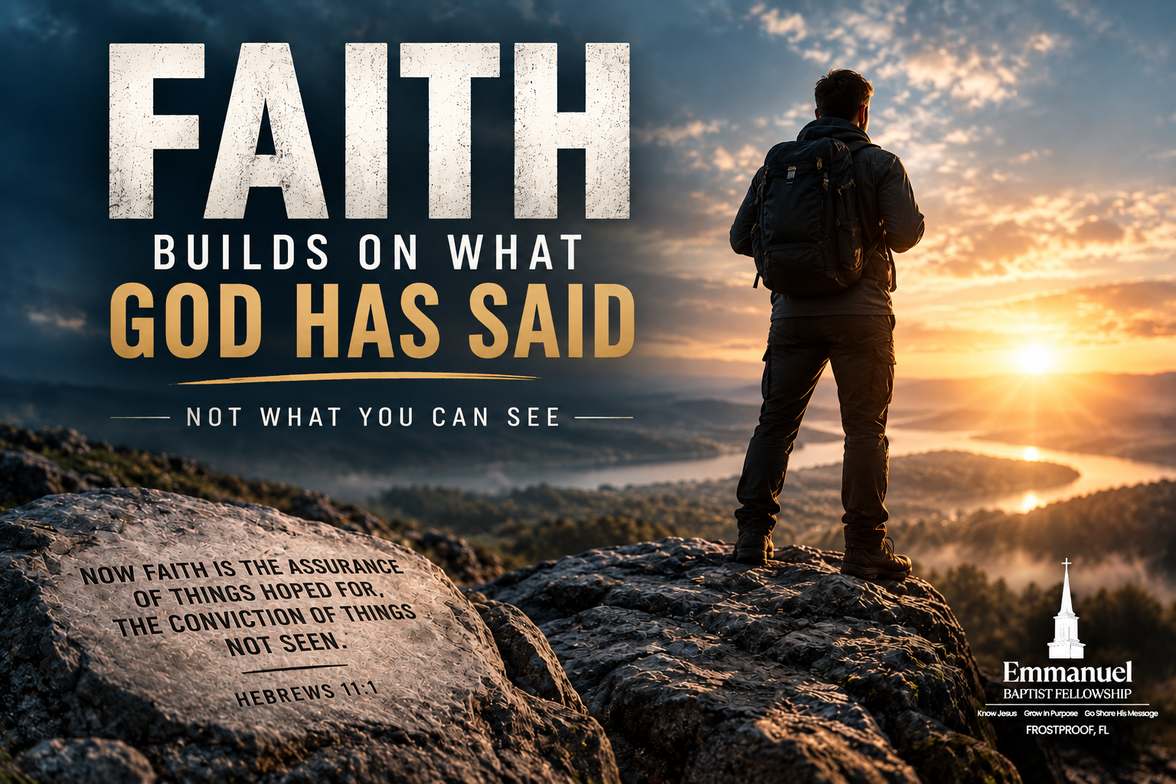
Hebrews 11:1 gives us the clearest biblical definition of faith: "Now faith is the assurance of things hoped for, the conviction of things not seen." - Hebrews 11:1
That word "assurance" in the original Greek is hupostasis, a compound word meaning "that which stands underneath." It is the idea of a foundation. Faith is not just a feeling or a wish. It is standing on something sure, something solid beneath you.
Think about the parable Jesus told about building on sand versus building on rock. When the storms come and the waves crash, what you are standing on determines whether you hold or fall. Faith is the firm foundation beneath your feet.
Faith Stands on What God Has Said, Not What You Can See
Faith rests on an unseen reality made certain by the character and the Word of God. In simple terms, faith treats what God has said as reality, even when you cannot see it yet.
Faith does not create reality. Faith stands on the reality that God has already spoken.
Consider a few examples of things that are invisible but undeniably real. You cannot see the wind, but you can feel it on your hand. You cannot see oxygen, but your life depends on it. You cannot see radio waves, but they carry voices across the world to the phone in your pocket. A hundred years ago, that would have sounded like madness. Today, you hold the evidence in your hand.
Human inability to see something has never been proof that it does not exist. The same is true of God.
What Does "Substance" and "Evidence" Mean in the Context of Faith?
The King James Version of Hebrews 11:1 reads: "Now faith is the substance of things hoped for, the evidence of things not seen." - Hebrews 11:1 (KJV)
The word "substance" here refers to what remains after everything else has been tested and stripped away. It is the settled residue of trust that has been tried. Faith is the stuff that stands when everything else cannot.
The word "evidence" or "conviction" is a legal term. It speaks to something that has been proved through trial and testimony. Faith is not blind. It is a conviction based on truth that has been tested and found reliable.
Faith is not confidence that God will do what you want. Faith is confidence that God will do what He said He would do.
The Invisible Is Not the Same as the Imaginary
One of the most important distinctions in understanding biblical faith is this: invisible and imaginary are not the same thing.
There was a time when the idea of microscopic germs making people sick would have sounded absurd. But germs did not need anyone's belief to exist. The earth did not stop spinning because people could not perceive it. Invisible waves did not stop carrying sound because no one could see them.
God does not need your belief to exist either. Just because He cannot be observed through a scientific test does not mean He is not real. Science investigates how creation works. Faith recognizes whose creation it is.
Why the First Example of Faith in Hebrews 11 Is You
Most people expect the hall of faith to begin with Abraham or Noah or Moses. But look at verse 3: "By faith we understand that the universe was created by the word of God, so that what is seen was not made out of things that are visible." - Hebrews 11:3
The first example of faith is not a hero from the past. It is us. It is the act of believing that God spoke this world into existence out of nothing, out of things that are invisible.
This is where faith and science seem to clash. Science works by observing, testing, and repeating results. Faith works in the opposite direction. Faith says, "God spoke it, I trust it," and then perhaps somewhere down the road, understanding follows. Faith gives you somewhere to stand while you are still trying to figure things out.
What the Hall of Faith Is Really Pointing To
As you read through the rest of Hebrews 11, it is tempting to look at figures like Noah, Abraham, Moses, and Sarah and think, "If only I had faith like theirs." But that is missing the point entirely.
- Abel could not see where obedience would lead. He trusted God anyway.
- Enoch walked with a God He could not see.
- Noah built an ark for rain he had never experienced.
- Abraham left for a country he had never seen.
- Sarah trusted a promise even when her circumstances seemed to contradict it.
- Moses chose God's unseen reward over Egypt's visible treasures.
The point is not how incredible these people were. The point is how incredible their God is. And He is your God too.
Why Intellectual Arguments Alone Cannot Sustain Your Faith
There is a real danger in treating faith as only an intellectual position. If someone can talk you into believing something, someone else can talk you out of it. This is why so many young people walk away from faith when they encounter a stronger argument in a classroom or online.
Faith must go deeper than ideas. It must be rooted in an encounter with the living God. When you have genuinely experienced His presence, His faithfulness, and His love, no argument can take that from you. It surpasses logic. It surpasses what can be explained.
"I trust in God, my Savior, the one who never fails." That kind of faith does not crumble under pressure because it is not built on a clever argument. It is built on a relationship.
How to Pray When You Are Struggling to Believe
There is a moment in Scripture where a desperate Father says to Jesus, "If you can, would you heal my daughter?" Jesus responds by pointing out the word "if." The man corrects himself: "If you will." And then he adds, "Lord, help my unbelief."
That is not a failure of faith. That is faith. It is coming to God honestly, standing on His Word, and trusting Him with the outcome even when you do not fully understand it.
God has already given every person a measure of faith. The challenge is not manufacturing more. It is stepping over and standing on what He has already provided through His Word.
What Faith Looks Like in Everyday Life
When circumstances challenge your faith, ask yourself three questions:
- What can I see right now?
- What has God said about this?
- Which one will determine how I live?
Faith does not deny what you can see. It refuses to believe that what you can see is all there is. Faith says, "God, this is what I hope for. This is what I want. If you will. But I am trusting you regardless, because I am standing on your Word."
Faith is only as reliable as its object. And the object of our faith is Jesus Christ, who Hebrews spent ten full chapters describing before ever listing a single example of faith. He is the reason faith is worth having.
If God said it, you can build your life on it.
Life Application
This week, identify one area of your life where you have been relying on what you can see rather than what God has said. It might be a relationship, a financial situation, a health concern, or a decision you are facing. Write down what God's Word says about that situation. Then make a conscious choice each day this week to stand on that truth, even when your circumstances seem to say otherwise. Pray honestly, like the Father in Scripture, and tell God exactly what you hope for while surrendering the outcome to Him.
Ask yourself:
- Am I treating faith like positive thinking, or am I actually standing on the Word of God?
- Have I had a genuine encounter with God, or is my faith only an intellectual position that could be argued away?
- In the area where I am struggling most right now, what has God actually said, and am I choosing to live by that?