What Does It Mean to Receive the Promised Eternal Inheritance?

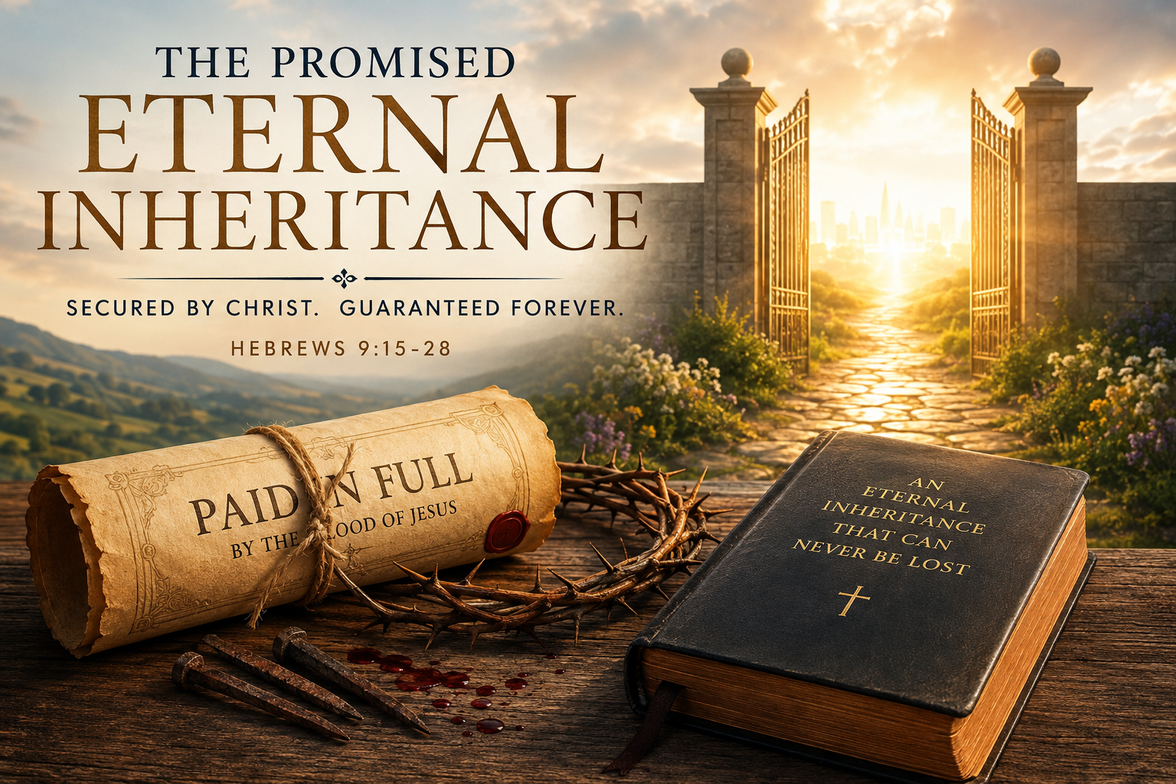
There are few words in Scripture that are as comforting as the phrase "the promised eternal inheritance." Every one of us understands the idea of an inheritance. Someone dies, a will is read, and what belonged to them is passed on to those they love. But every earthly inheritance has limits. It can lose value, be divided among heirs, disappear through poor decisions, or eventually be forgotten.
Hebrews 9 tells us about an inheritance that will never fade because it was secured by a Savior who will never fail.
The writer repeatedly uses one simple word throughout this passage:
Once.
Jesus died once.
He offered one sacrifice.
He secured one eternal inheritance.
And He will appear one more time—not to deal with sin again, but to bring His people home.
Why Did Jesus Have to Die?
That is one of the most common questions people ask.
"Why couldn't God just forgive sin?"
The answer is found in the very character of God.
God is perfectly holy.
God is perfectly just.
Because He is just, sin cannot simply be ignored. A judge who overlooks guilt is not a good judge. Justice requires that sin be dealt with.
Hebrews 9:22 states it plainly:
"Without the shedding of blood there is no forgiveness of sins."
The word translated forgiveness carries the idea of a complete release, a cancellation of debt, a full pardon. God is not pretending our sin never happened. He is declaring that the debt has been fully paid.
That payment required the giving of life.
Jesus did not merely shed blood.
He willingly gave His life.
How Do God's Justice and Love Meet at the Cross?
Imagine a king who discovers someone has been stealing from the royal treasury. Wanting to uphold justice, he decrees that the guilty person will receive severe punishment. Eventually the thief is caught, and to everyone's surprise it is the king's own daughter.
If he ignores his own law, he is no longer just.
If he enforces the punishment, he appears to have no mercy.
The king walks to the place of punishment, removes his royal robe, wraps himself around his daughter, and commands the sentence to continue. Every blow intended for her falls upon him instead.
Justice is satisfied.
Love is displayed.
Neither is compromised.
As moving as that illustration is, the cross is infinitely greater.
God did not merely stand beside us in our suffering.
He came to us.
Jesus willingly took our place, bearing the judgment our sins deserved.
As Paul writes in Romans 3:26, God remains both "just and the justifier" of those who trust in Christ.
What Is the Promised Eternal Inheritance?
Hebrews 9:15 tells us that Christ became the Mediator of a new covenant:
"Therefore he is the mediator of a new covenant, so that those who are called may receive the promised eternal inheritance."
Notice that the inheritance is promised, eternal, and only available because Christ died.
Just as a will only becomes effective after the death of the one who made it, Christ's death put every promise of the New Covenant into effect.
But what exactly did He purchase?
The New Testament describes an inheritance far greater than many people imagine.
It includes:
-
complete forgiveness of sin,
-
eternal life,
-
adoption into God's family,
-
a cleansed conscience,
-
the indwelling Holy Spirit,
-
every spiritual blessing in Christ,
-
a resurrected body,
-
a new heaven and new earth,
-
and the privilege of living forever in God's presence.
Above all else, our greatest inheritance is God Himself.
In the Old Testament, Israel inherited a land.
Under the New Covenant, believers inherit a relationship that can never be broken.
The greatest gift of the gospel is not simply escaping hell or entering heaven.
It is belonging to God forever.
Why Is Our Inheritance Called Eternal?
Every earthly inheritance eventually comes to an end.
Money loses value.
Homes deteriorate.
Possessions wear out.
Families divide estates.
Eventually everything in this world passes away.
Our inheritance in Christ is completely different.
It cannot be stolen.
It cannot lose value.
It cannot be divided.
It cannot expire.
Peter describes it as an inheritance that is "imperishable, undefiled, and unfading, kept in heaven for you." (1 Peter 1:4)
Because our inheritance is secured by an eternal Savior, it is every bit as eternal as He is.
Why Did Jesus Only Have to Die Once?
Under the Old Covenant, sacrifices never stopped because they never finished the job.
Day after day...
Year after year...
Another sacrifice.
Another reminder of sin.
Another priest.
But Hebrews keeps emphasizing one word:
Once.
Christ entered the true heavenly sanctuary—not with the blood of animals—but with His own blood.
His sacrifice was perfect because He was perfect.
Nothing could be added.
Nothing needed to be repeated.
Think of making the final payment on a mortgage.
The day the loan is completely paid, the bank does not send another monthly bill.
The debt has been satisfied.
The cross is heaven's declaration:
Paid in Full.
Jesus did not begin your salvation.
He completed it.
What Happens When Jesus Returns?
Hebrews 9 closes by lifting our eyes beyond the cross.
"It is appointed for man to die once, and after that comes judgment... so Christ, having been offered once to bear the sins of many, will appear a second time... to save those who are eagerly waiting for him."
The first time Jesus came, He came to deal with sin.
The second time He comes, He will not return to make another sacrifice.
That work is already finished.
He is coming to complete our salvation by bringing His people into the full enjoyment of the inheritance He has already secured.
For believers, the Second Coming is not something to fear.
Jesus is not returning to determine whether His sacrifice was enough.
He is returning because it was enough.
The next time He appears, He is not coming to carry your sins.
He is coming to bring you home.
Life Application
Spend some time this week thinking about everything Christ has already secured for you.
Thank Him not only for the promise of heaven but for the blessings you already enjoy today—forgiveness, adoption into God's family, peace with God, the presence of the Holy Spirit, and the assurance that your future is secure.
Then ask yourself:
-
Am I living like someone trying to earn God's acceptance, or like someone who has already received an eternal inheritance through Christ?
-
Is there guilt I continue carrying even though Jesus has already paid for it?
-
Which part of my inheritance in Christ do I need to remember most today?
-
Am I eagerly anticipating Christ's return, or have I become too comfortable living only for this world?
Everything around us eventually wears out, expires, or must be repeated.
But the work of Jesus never will.
His sacrifice was offered once.
Your inheritance is eternal.
And one day, the Savior who purchased it will return to bring you home.