That's Where I'll Stand

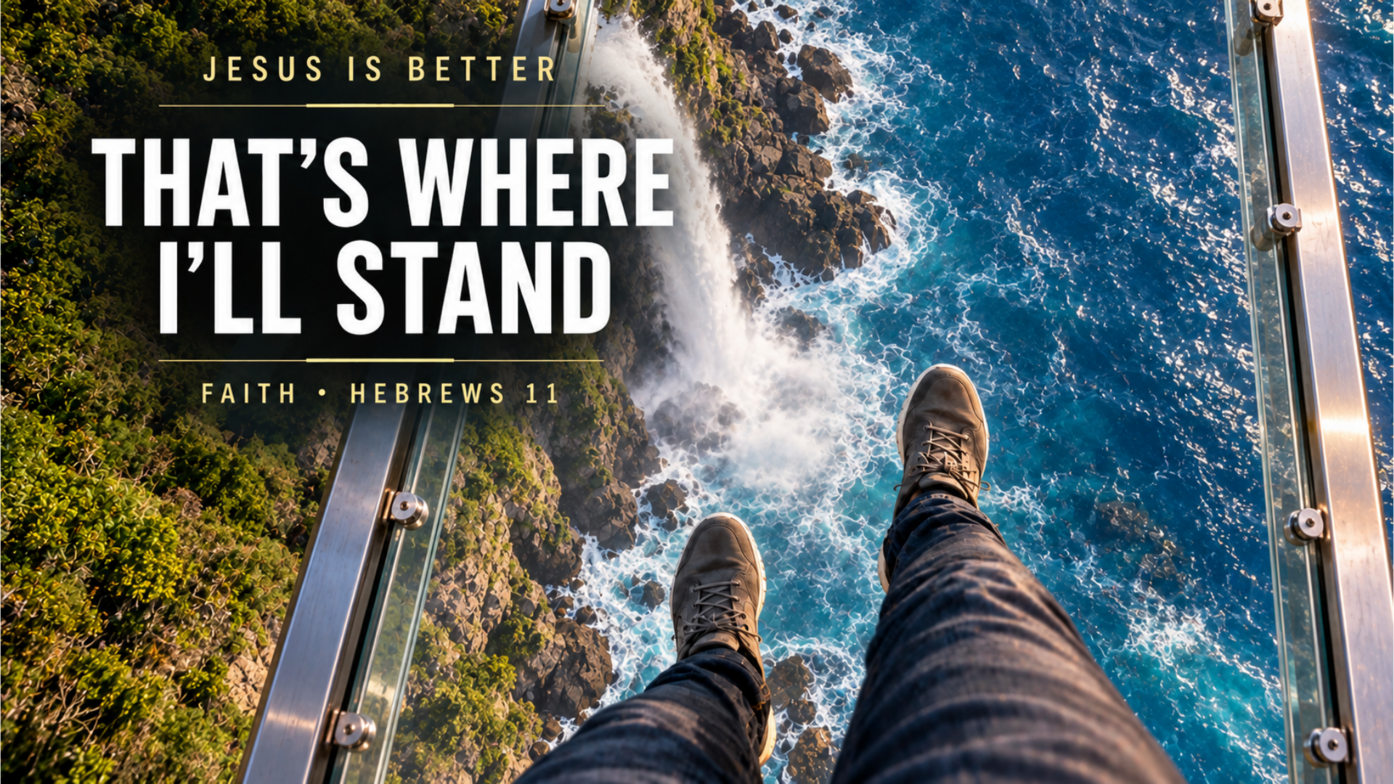
Faith is more than a feeling or a belief you hold in your head. It is a foundation you stand on, a daily walk you commit to, and an obedience you act on even when nothing around you makes sense. Hebrews 11 gives us a front-row seat to what that kind of faith actually looks like in real people with real lives.
What Does It Really Mean to Have Faith?
Hebrews 11:1 says, "Now faith is the assurance of things hoped for, the conviction of things not seen." The King James Version calls it "the substance of things hoped for, the evidence of things not seen."
The Greek word behind "assurance" or "substance" is hupostasis, which carries the idea of a foundation, something that stands beneath everything else. Faith is not a denial of reality. It is the recognition that there is more to life than what we can see and touch.
Faith places the full weight of our lives on the God who spoke the world into existence. It is easy to say we trust God while keeping both feet on ground we can see. But real faith steps forward and puts its full weight on Him.
Is Hebrews 11 Just a Hall of Fame We Walk Through?
It is tempting to read Hebrews 11 the way you might walk through a sports Hall of Fame, stopping to admire what great people accomplished and then moving on. But that misses the entire point.
These stories are not recorded to show us how great those people were. They are recorded to show us how great their God was. And here is the part that changes everything: their God is our God. We are not meant to observe these people from a distance. We are meant to stand among them.
Faith That Worships: What Can We Learn from Abel?
Abel was the second son of Adam and Eve. He kept sheep while his brother Cain worked the ground. Both brought offerings to God. God accepted Abel's offering but not Cain's, and Cain's anger eventually led Him to murder His brother.
The difference between the two offerings was not simply the type of gift. Hebrews 11:4 says, "By faith Abel offered to God a more acceptable sacrifice than Cain, through which He was commended as righteous, God commending Him by accepting His gifts. And through his faith, though he died, he still speaks."
Genesis 4:4 tells us that Abel brought the firstborn of his flock and the fat portions, meaning he brought the first and the best. His offering reflected the worthiness of God. Cain approached God on His own terms. Abel approached God believing He was worthy of everything.
What Does Abel's Story Mean for Us Today?
We still decide how we will approach God. Will our worship be convenient, or will we give Him our best? Will we give God what is left over, or will we honor Him with our first?
Faithful worship is not measured by what we bring. It is measured by the heart behind it, the trust and honor we have for the God we are bringing it to. When the world treats worship casually, we can choose to stand with Abel and bring God our first and our best.
Faith That Walks: What Can We Learn from Enoch?
Genesis 5 records a long genealogy with a repeated pattern. Person after person is introduced, and then the record ends the same way: "and he died." Over and over again. Until we reach Enoch.
The pattern breaks. Genesis says Enoch walked with God and was not, for God took Him. Hebrews 11:5 says, "By faith Enoch was taken up so that he should not see death, and he was not found, because God had taken Him. Now before he was taken he was commended as having pleased God."
Enoch lived in a generation moving rapidly toward the corruption and violence that would eventually bring Noah's flood. The culture was drifting away from God. Enoch walked the other direction.
Why Is Walking with God Every Day So Important?
Hebrews 11:6 follows directly from Enoch's story: "And without faith it is impossible to please him, for whoever would draw near to God must believe that he exists and that He rewards those who seek Him."
Enoch's testimony was not built on one dramatic moment. There was no single event, no famous sermon, no great miracle attached to his name. It was simply his everyday walk with God, His ordinary choices made consistently over a lifetime.
Most of the Christian life is not lived in dramatic moments. It is lived on ordinary Tuesdays and difficult Thursdays, in the unnoticed seasons that pass quickly. Walking with God means prayer, Scripture, repentance, and trust carried through every one of those days, not just Sundays.
We cannot walk with God on Sundays while deliberately walking away from Him the rest of the week. Faith is not a one-time decision. It is a daily walk with the God we have chosen to trust.
Faith That Obeys: What Can We Learn from Noah?
Hebrews 11:7 says, "By faith Noah, being warned by God concerning events as yet unseen, in reverent fear constructed an ark for the saving of His household. By this he condemned the world and became an heir of the righteousness that comes by faith."
Humanity had become deeply corrupt. Genesis 6:5 says that every intention of the human heart was continually evil. God warned Noah of a coming judgment that no one had ever seen and commanded Him to build an ark. Noah had never seen rain. The people around him had never seen rain. And yet Noah believed God and obeyed.
Genesis 6:22 summarizes it simply: "Noah did this; he did all that God commanded Him." His obedience was public, costly, and demanding. He preached for a hundred years. The only people who got on the ark were his own family. By the world's measure, it looked like failure. But Noah is in the hall of faith because he obeyed completely.
What Is the Difference Between Agreeing with God and Obeying God?
Noah did not merely agree with God. He acted on what God said. There is a real difference between nodding along and actually building the ark.
His reverent fear did not paralyze him. It motivated him. He took God seriously and let that drive His obedience, even when no one around Him understood why.
We are also asked to live according to things we have not yet seen. We believe Christ will return. We believe judgment is real. We believe eternity matters. If we truly believe those things, then like Noah, we should be about our Father's business, even when the culture looks down on it.
Faith becomes visible when belief turns into obedience. As Scripture says, faith without works is dead. Works do not create faith, but they are the evidence of it. Saying you trust the glass bridge while refusing to step on it is not faith. Faith is stepping out and putting your full weight on what God has said.
What Do Abel, Enoch, and Noah Have in Common?
Three different people. Three different stories. Three different expressions of faith. But all three received the same testimony: God commended them.
- Abel drew near to God in worship.
- Enoch walked in daily fellowship with God.
- Noah responded to God in obedience.
Hebrews 11:2 says, "For by it the people of old received their commendation." The "it" is faith. Faith is what ties all of their stories together, and it is what ties us to them.
None of them knew how their story would be remembered. They simply believed God and lived accordingly. We may never be remembered for our worship, our walk, or our obedience. But God has it written down, and that is enough.
Life Application
This week, choose one specific area where your faith needs to move from agreement to action. Maybe it is bringing your first and best to God in worship rather than what is left over. Maybe it is rebuilding a daily habit of prayer and Scripture that has grown inconsistent. Maybe it is something God has already told you to do that you have been putting off.
Pick one. Take one step. Put your full weight on what God has said.
Ask yourself these questions as you go into the week:
- What am I holding back from God in my worship? Am I bringing Him my best, or just what is convenient?
- Where has my daily walk with God become distant or inconsistent? What would it look like to walk with Him through the ordinary moments this week?
- What has God already told me to do that I have not done yet? What is one step of obedience I can take this week, even if it does not make sense to the people around me?
God is worthy. God is faithful. God can be trusted. That is where we stand.